It’s Tuesday afternoon and someone just canceled their balayage appointment via a text that read, verbatim, “something came up sorry!!”. The stylist checks the book. The chair sits empty. This is, structurally, the same feeling as a canceled dinner reservation, except instead of losing a table you lose ninety dollars and forty-five minutes of a Tuesday you will never get back.
Let’s talk about the particular economics of empty chairs, empty tables, empty rooms. All these perishable little windows of time that businesses sell, and how strange it is that the tools most of them use to fill those windows are the same tools we’ve all been ignoring since 2013.
Phone Calls Aren’t Working
Nobody picks up a call from a number they don’t recognize anymore. So the front desk calls about a last-minute opening, it goes to voicemail, the voicemail gets discovered three days later wedged between a dentist reminder and spam, and by then the slot’s long gone.
Texts don’t have that problem. People read them almost immediately, sometimes mid-conversation with an actual human, which says a lot about our priorities but works great for your calendar. Open rates sit north of 90%, usually within a few minutes. Email is still out here hoping someone opens the newsletter.
The System, Such As It Is
What salons and spas are discovering is that the fix for an empty chair isn’t more advertising or a better Instagram grid. It’s a waitlist, and a text.
The mechanics are simple:
- A client cancels.
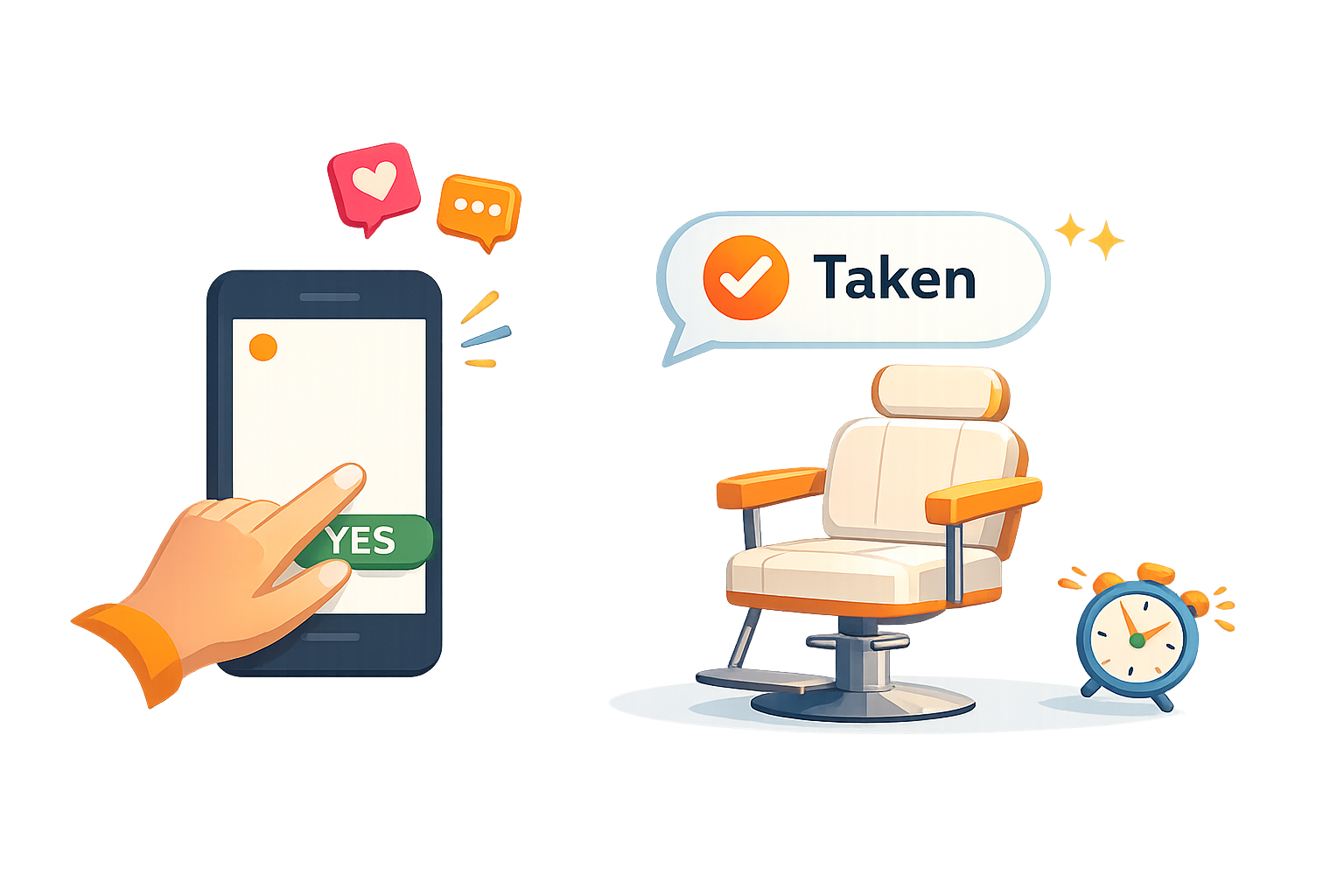
- A text goes out to a list of people who’ve said, in effect, “text me if something opens up.”
- Whoever replies first gets the slot.
- Everyone else gets a polite “this one’s taken” and stays on the list for next time.
It’s closer to the group chat logic of “does anyone want my Knicks tickets, I can’t go tonight”. Fast, casual, and familiar to anyone who’s ever tried to offload something on short notice.
The people who respond well to this tend to be the ones with some slack in their schedule — freelancers, remote workers, retirees, people whose Tuesday afternoons are more theoretical than fixed. Build a list of those clients specifically, and you’ve assembled something like an on-call bench for your own business.
Where Automation Comes In
Doing this by hand, one text at a time, from the front desk, between actual clients, is a fine way to burn out a receptionist by Thursday. This is the part where software like Mobiniti takes over: platforms that can detect a cancellation the moment it happens and fire off the waitlist text automatically, without anyone stopping what they’re doing to type it.
Mobiniti’s texting tools are built around exactly this gap: automated alerts the second an opening appears, two-way texting so a client can reply “yes” and lock in the slot without a phone call, and scheduling that syncs directly with what’s happening in the calendar. The empty chair problem doesn’t disappear, but it stops being your problem to manually solve five times a day.
A Few Notes on Not Wasting the Text
Not every last-minute text gets a reply, and the difference tends to come down to specificity and speed. Be specific. “We have an opening today” invites nothing. “2:15pm with Jordan, gel manicure, reply YES to grab it” gives someone a decision to make.
Consider a small incentive. A modest discount on a last-minute slot doesn’t just fill today’s chair, it trains people to keep an eye on these texts going forward. Keep it short. Nobody is reading three paragraphs to decide about a same-day blowout.
In Conclusion
Every empty appointment slot is money that was, at some point, already spoken for and then wasn’t. Over a week, a month, a year, those slots add up to a quietly significant loss.
You don’t need a bigger budget or a fancier CRM. You need to tell the right person, right now, that a spot opened. And you need a system that does it automatically so you can stay focused on the client already in your chair.
Text the list. Fill the chair. Go back to your Tuesday.
Mobiniti.com