High-emotion sports moments like the Knicks’ first championship since 1973 are some of the best list-building and engagement windows you’ll get all year. Don’t capitalize on a cultural moment. Participate in it.
The New York Knicks won the NBA Championship on June 13th, defeating the San Antonio Spurs in Game 5 to claim their first title in 53 years. This entire playoff run was a masterclass in playing the long-game and delayed gratification.
For anyone who sells anything to anyone who likes basketball (or who simply wanted to capitalize on one of the most emotionally charged sports moments a huge portion of the population in the United States has experienced in half a century) the question of how you stay connected to your audience during and after a moment like this is a good one. And the answer runs through SMS!
Why SMS holds up better than every other channel at high-emotion moments
There’s a version of this argument that sounds too simple: people have their phones on them when they’re watching sports, therefore text them. But the mechanics behind it are more interesting than that.
SMS carries a 98% open rate, compared to roughly 21% for email. Which means that if you sent a message during halftime of Game 5, while the Knicks were trailing and the whole city was holding its breath, there’s a near-certainty it got seen by someone whose emotional investment was already high.
That immediacy is the thing email has never been able to replicate and social media has never been able to guarantee. When Brunson hit his 15th-quarter point to seal the championship, that was not the moment to be depending on your email open rate.
What sports teams can teach businesses:
The Milwaukee Bucks grew their SMS subscriber list by 455% year-over-year between 2023 and 2024 using in-game activations (polling fans during halftime races, rewarding the winners with discounts, building a list of people who had already raised their hands to say they wanted to hear from the team). The Carolina Panthers ran a corgi race (a literal corgi race) with audience voting via SMS and a 30% coupon for fans who picked the winner.
The common thread is that they treat the high-engagement moment (the game, the playoff run, the championship) as a list-building opportunity, not just a content opportunity. The goal isn’t to get someone to double-tap a post; it’s to get them to opt in to a direct line of communication that you control, that doesn’t depend on an algorithm made by a company that doesn’t care about you deciding whether your message is worth surfacing.
For businesses adjacent to sports fandom (bars, restaurants, merchandise retailers, sports-adjacent services of any kind) the Knicks’ championship run was an extended window of elevated attention. The fan who texted in their prediction about the Spurs series and got a discount code in return is now on your list.
Invest in the off-season:
Conventional approach to sports-adjacent marketing: spend heavily during the season, go quiet during the off-season, repeat.
It is a reliable way to make your audience feel like you only care about them when there’s something obvious in it for you. Which is, coincidentally, also how people feel when the only texts they get from a brand are promotional blasts.
A Deloitte survey found that more than 60% of fans say a great year-round experience would make them more likely to be engaged with a team in the coming season, and 55% said it would make them more likely to purchase a ticket in the future. The appetite for connection—for community—doesn’t disappear when the Finals end.
This is especially true right now, in the particular afterglow of what the Knicks just did. The emotional residue of a 53-year drought ending (of Brunson crying on the court, of MSG erupting, of a city that has been waiting since 1973 finally getting its moment) doesn’t evaporate on June 14th. It lingers, and it creates an unusual window for brands to meet fans in an authentic, warm emotional state rather than a commercially primed one.
Off-season SMS doesn’t have to be aggressive. It can be a behind-the-scenes look at something happening in the business, a piece of content that nods to the shared experience (the Knicks won; we’re still celebrating; here’s something for you), a poll that gives subscribers a reason to reply. Off-season SMS communication can include player signings, community events, or behind-the-scenes content to keep fans excited and connected. And for a business, the same principle applies with its own version of those touchpoints.
How to use this moment, thoughtfully:
The Knicks won. They are the first team to win both the NBA Cup and an NBA Championship in the same season. Jalen Brunson is going to be on the cover of everything through the summer. New York is in a particular kind of mood that doesn’t come around often, and the collective mood/hype that a huge portion of the United States is experiencing should be met with care, rather than just trying to sell into.
Don’t capitalize on a cultural moment. Participate in it.
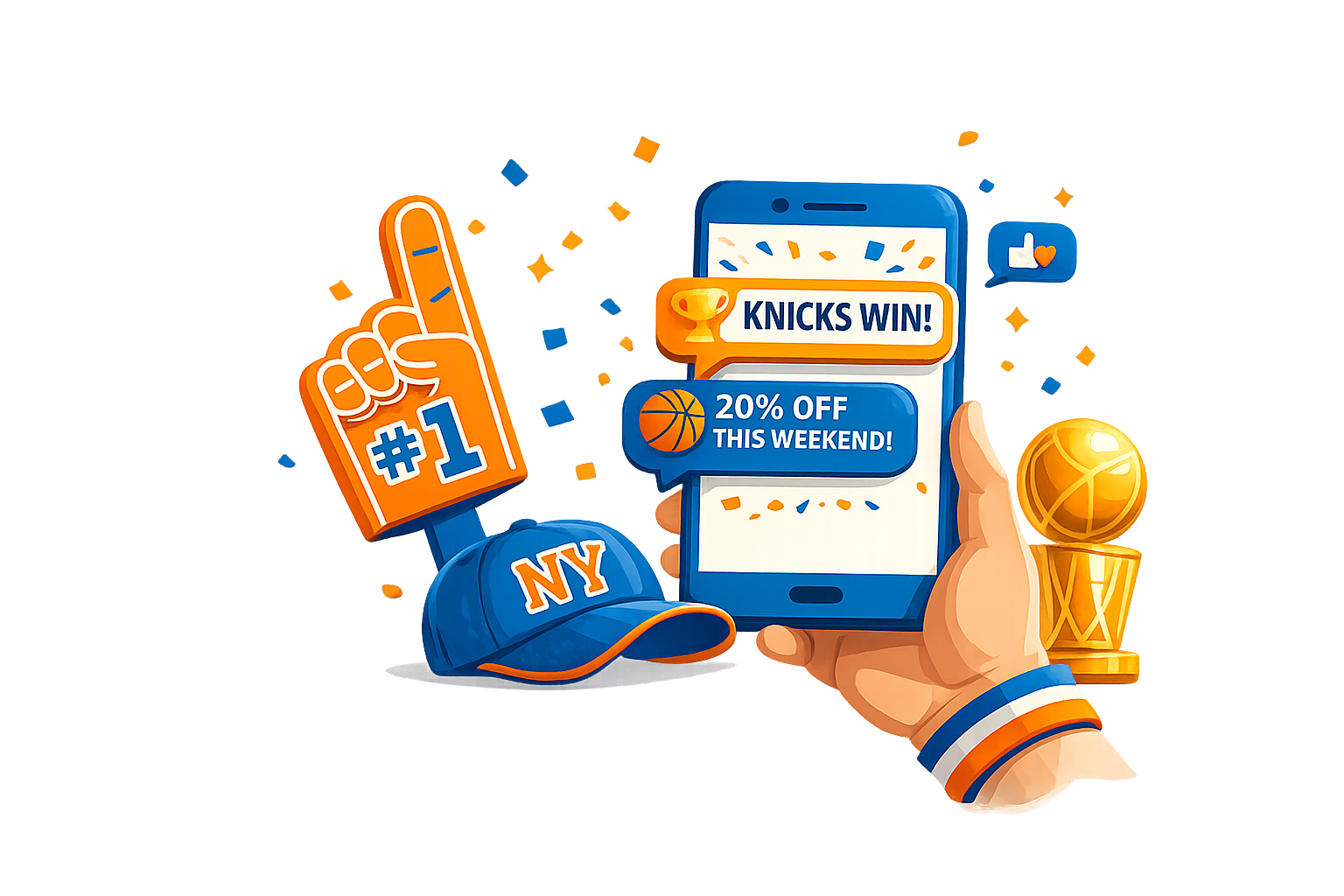
A text that says “Celebrate the Knicks with 20% off this weekend” is capitalizing. A text that says “We stayed up for all five games too! Here’s something for the real ones.” is participating.
People buy from brands they feel warmth toward, and they feel warmth toward brands that treat them like people rather than conversion events. SMS, done well, is one of the more effective tools for creating that warmth precisely because it lives in the same place as messages from the subscriber’s friends and loved ones.
The Finals are over. The off-season is here. What you decide to do with it and how you choose to engage could make ALL the difference.
At Mobiniti, we’re always here to help you join the zeitgeist in a meaningful way that feels good for you AND your subscribers.