
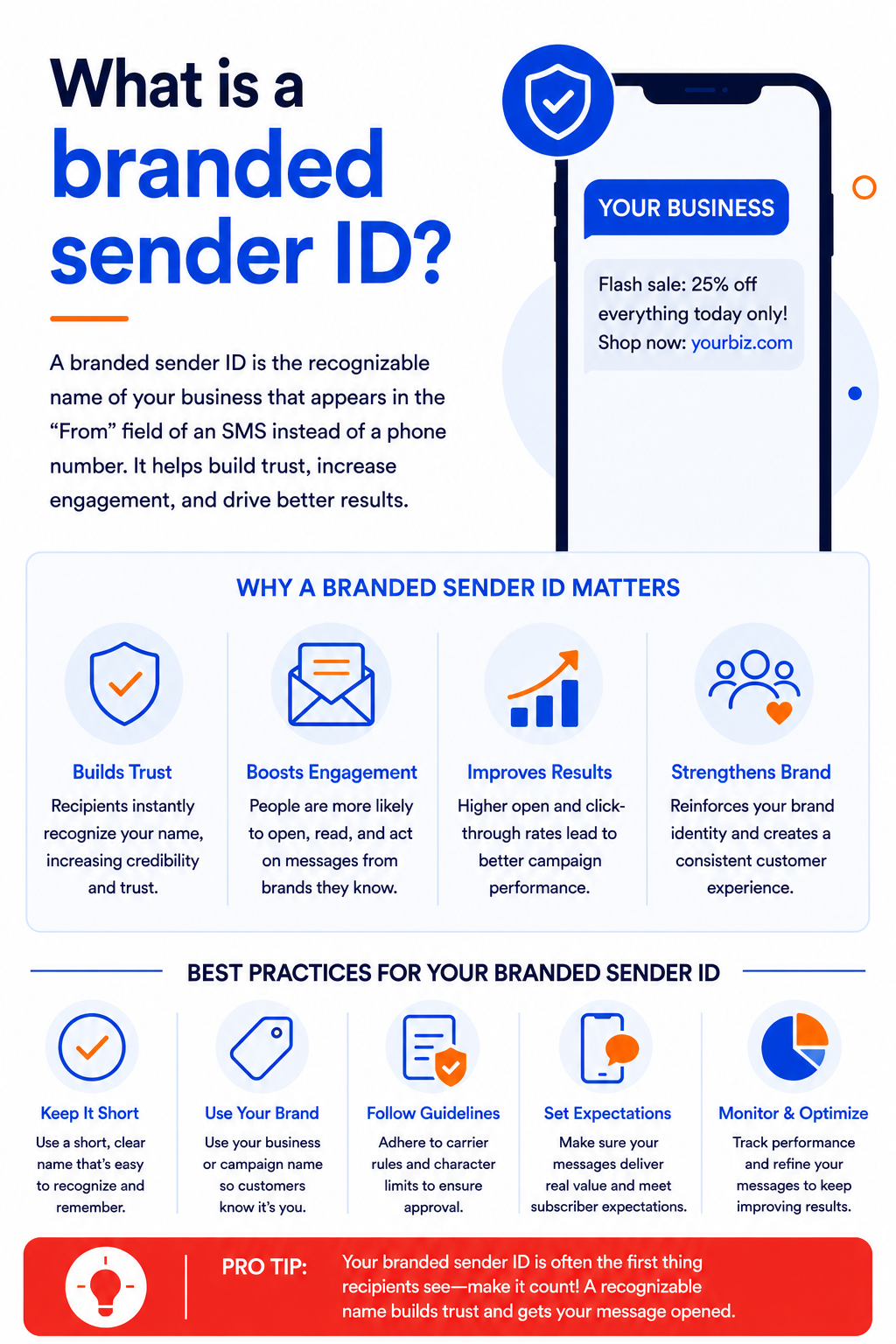
A branded sender ID is an alphanumeric sender name (usually 3–11 characters) that appears in the “From” field of an SMS message instead of a phone number. It’s commonly used in international business messaging to display a recognizable brand name like “MOBINITI” or “ACMEDEALS” when a company sends text messages to customers.
How branded sender IDs work
With standard SMS, messages are typically sent from a phone number (short code, toll-free, or 10-digit local number). A branded sender ID replaces the number with a text label, so recipients immediately see who the message is from.
In many countries, branded sender IDs are a default option for business SMS. They are especially common for:
- Delivery and appointment notifications
- One-way alerts (service updates, reminders, announcements)
- Brand-forward marketing where recognition matters
Branded sender IDs are primarily an international concept. In the United States and Canada, business texting usually relies on phone-number-based sending (10DLC, toll-free, or short codes), not alphanumeric sender IDs.
What a branded sender ID looks like to recipients
Instead of showing a phone number like (888) 555-1212, the message shows something like:
- ACMESHOP
- MYBRAND
- SUPPORT
This improves immediate recognition, especially when customers don’t already have your number saved.
Key benefits of branded sender IDs
Instant brand recognition
The main advantage is clarity: recipients know who is texting them without needing to read the message first. That can improve engagement for legitimate programs (notifications, confirmations, reminders).
Consistent sender identity across campaigns
With phone numbers, brands sometimes manage multiple sending numbers (different regions, departments, or vendors). A branded sender ID can create a consistent “From” identity, which is useful when building trust across recurring messaging.
Useful for one-way informational messaging
In many markets, branded sender IDs are best suited for one-way messages where the user doesn’t need to reply. That aligns well with alerts, reminders, and transactional updates.
Limitations you should know (important)
Branded sender IDs have tradeoffs that matter for customer experience and compliance.
Replies may not work (or may not reach you)
In many countries and carrier environments, recipients cannot reply to an alphanumeric sender ID. Even when a device allows a reply, the response may not route back to the business. That makes branded sender IDs a poor fit for support conversations or interactive flows.
If two-way texting is required, a phone-number-based sender (local, toll-free, or short code) is usually the better choice.
Not universally supported
Sender ID support varies by country and carrier. Some markets allow alphanumeric sender IDs broadly, while others restrict them or require registration. Even within a supported country, specific carriers may handle sender IDs differently.
Filtering and spoofing risk
Because branded sender IDs are not tied to a unique phone number in the same way, some markets treat them as higher-risk for spoofing. That can lead to stricter filtering rules or mandatory sender ID registration.
Legitimate programs can still perform well, but the sender ID must be properly configured and compliant with local rules.
Branded sender ID rules and formatting constraints
Most branded sender IDs follow common formatting rules (though exact requirements vary):
- Length: commonly 3–11 characters
- Characters: letters A–Z and numbers 0–9 (special characters often not allowed)
- Spacing: sometimes allowed, often discouraged
- Case: usually not important, but uppercase is common
Practical guidance: keep it short, readable, and clearly tied to your brand name. Avoid generic terms like “INFO” or “NOTICE” unless they are strongly associated with your business.
Branded sender IDs vs phone-number sending
Choosing a sender type is a decision about both deliverability and customer experience.
When branded sender IDs are a good fit
- You are messaging outside the U.S./Canada where sender IDs are supported
- Your messages are primarily one-way (alerts, confirmations, reminders)
- You want immediate brand recognition without requiring a saved contact
- You do not rely on customer replies for support or workflows
When a phone number is a better fit
- You need two-way conversations (support, lead capture, back-and-forth texting)
- You operate mainly in the U.S. where 10DLC/toll-free/short codes are standard
- You need stable opt-out keyword handling through a dedicated messaging number
- You want a consistent reply path for customer engagement
For businesses deciding between number-based sending options, Mobiniti supports multiple code types. See SMS number options.
Compliance considerations for branded sender IDs
Even when a sender ID is allowed, business texting still requires permission-based practices. Industry expectations include:
- Clear consent for promotional messaging
- Accurate identification of the sender (no misleading brand names)
- Respect for opt-outs where supported (local rules vary)
- Content alignment with what the subscriber agreed to receive
Because reply-based STOP handling may not be available with sender IDs, opt-out mechanisms sometimes need to be handled through alternative workflows depending on country rules and carrier support.
Best practices for using branded sender IDs effectively
- Keep the sender ID consistent: changing sender names can confuse recipients and reduce trust.
- Use it where it’s supported: sender ID behavior is country-specific—test per region.
- Design messages for one-way delivery: don’t ask questions that require a reply unless you have a two-way path.
- Include brand context in the message body: even with a sender ID, confirm identity and purpose quickly.
- Monitor engagement: low engagement or high complaint signals can increase filtering risk.
How Mobiniti fits into sender identity choices
Mobiniti supports business texting programs that rely on phone-number-based sending (local 10DLC, toll-free, and short codes), which is the standard approach for U.S. and many two-way messaging workflows. If your priority is interactive texting and support, Mobiniti’s two-way SMS inbox is designed for conversational messaging at scale.
For marketing programs that need list growth, segmentation, and campaigns, Mobiniti also provides tools for SMS marketing campaigns.
